
The Problem With How Cities Use Water
The traditional municipal water model was built for a different era. Cities draw from surface water and aquifers, treat it, distribute it, collect the wastewater, treat it again, and discharge it — usually into a waterway, where it's lost to the local system entirely. Every gallon discharged is a gallon that has to be replaced.
For decades, that model worked well enough. Populations were smaller, aquifer levels were stable, and drought cycles were manageable. None of those conditions apply to Central Texas today.
The Edwards Aquifer is under sustained pressure. Surface water rights are increasingly contested. The Highland Lakes system that supplies much of the region operates under allocation agreements that don't account for the growth rates Williamson County is now experiencing. Cities like Hutto are growing faster than the infrastructure assumptions that were built to serve them.
The answer isn't to find more water. It's to stop losing the water you already have.
A Different Model Entirely
Circular water recovery starts with a simple premise: treated wastewater is not waste. It's a resource that has already been partially processed, and with the right treatment train, it can be returned to the potable water supply safely, reliably, and cost-effectively.
HuttoFlow captures treated effluent from Hutto's existing wastewater infrastructure before it's discharged. That effluent moves through a multi-stage advanced treatment process — removing contaminants, pathogens, and impurities to levels that meet or exceed federal and state drinking water standards. The result is clean, safe, reusable potable water returned directly to the supply.
Nothing is wasted. Nothing is discharged that doesn't need to be. The system doesn't replace Hutto's existing water infrastructure — it layers on top of it, extending the capacity of what's already there without requiring new wells, new water rights, or new surface water allocations.
That's the model. Proven in practice internationally. Now being engineered for Central Texas.
How the Treatment Process Works
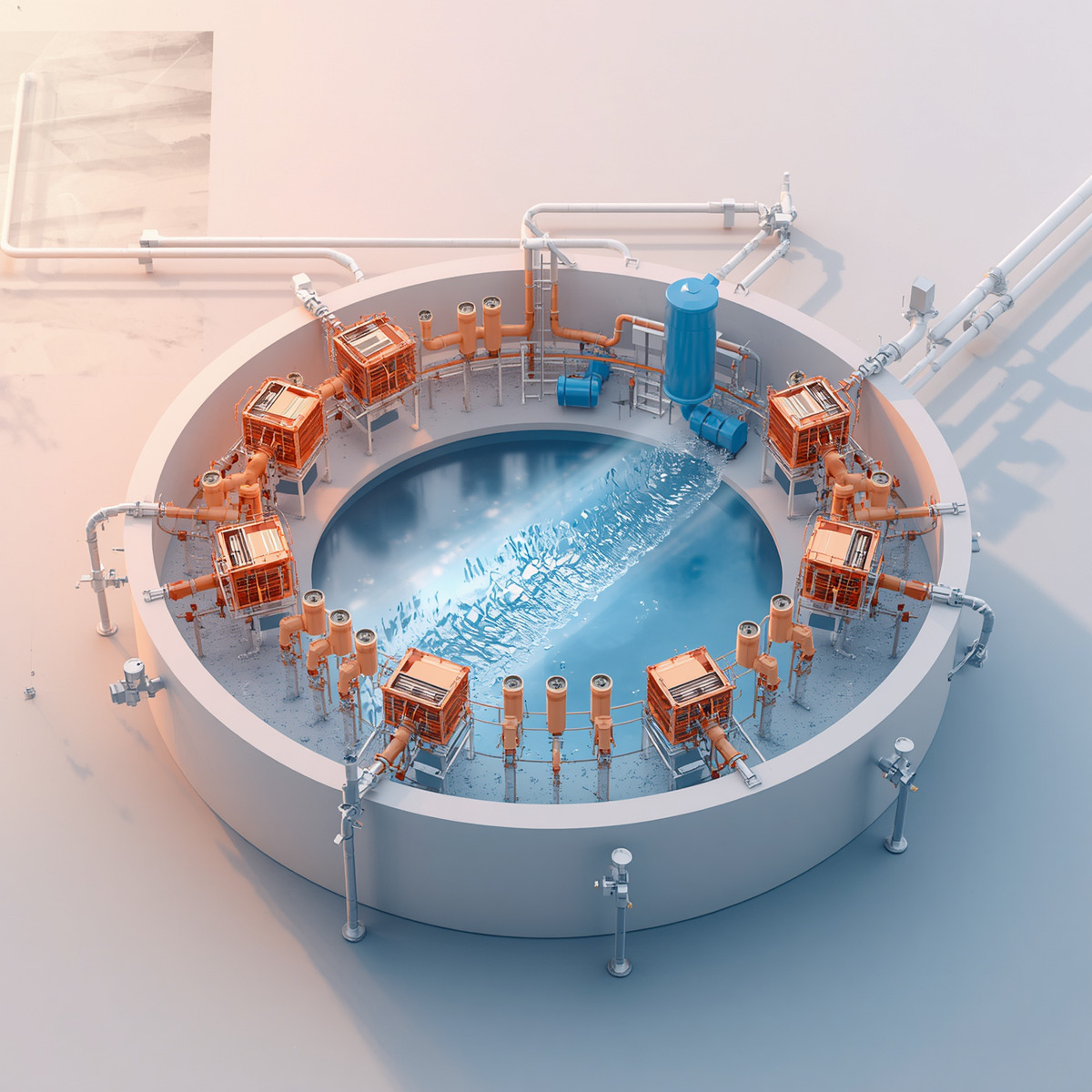
HuttoFlow uses a multi-stage advanced treatment train — a sequence of proven water treatment technologies applied in series to progressively refine treated effluent into potable water. Each stage targets a specific category of contaminants. The combination produces water that meets or exceeds EPA and TCEQ drinking water standards.
A Phased Approach Built for Real-World Conditions
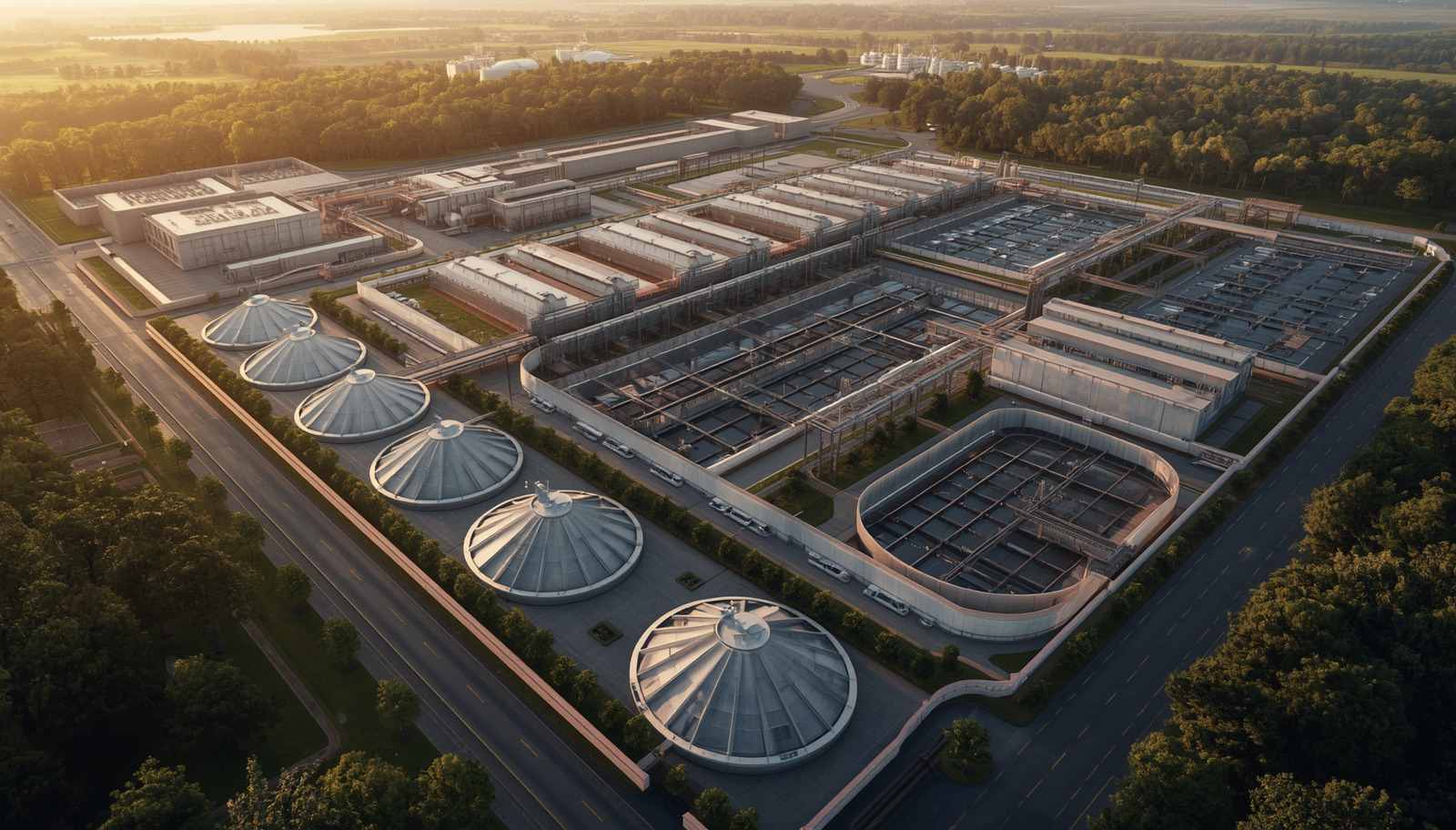
HuttoFlow doesn't ask Hutto — or any investor — to commit to full-scale infrastructure on day one. The system is structured in three phases, each building on the last, each generating data and operational proof before the next phase begins.
Phase 0 — Pilot Demonstration
Capacity: 20,000 GPD
The pilot exists for one purpose: to prove the system works under real Central Texas operating conditions and generate the data required to advance through TCEQ's regulatory pathway. Located on the site adjacent to Hutto's existing wastewater treatment plant, the pilot is a compact but fully functional demonstration system — not a model, not a simulation. It processes real effluent, produces real potable water, and generates real compliance data. Everything that follows depends on what the pilot proves.
Phase 1 — Operational Deployment
Capacity: Meaningful expansion beyond pilot
With pilot data confirmed and regulatory milestones achieved, the system scales at the triangle site. Vertical stacking technology increases production capacity within the same physical footprint — a critical advantage in a land-constrained urban environment. Phase 1 establishes HuttoFlow as Hutto's first operational circular potable water asset, directly supporting the city's housing growth trajectory and long-term water resilience. The Eco-Science Park begins to take shape around the facility.
Phase 2 — Full-Scale System
Capacity: Up to 6 Million GPD across Hutto's full system
The complete build-out. Full-scale circular water production integrated across Hutto's water infrastructure, with eco-product outputs, stormwater reintegration, and energy-efficient treatment processes operating as a closed-loop ecosystem. At full scale, HuttoFlow doesn't just supplement Hutto's water supply — it fundamentally changes the city's relationship with water scarcity.
Built to Meet the Highest Regulatory Standard
HuttoFlow operates within Texas's existing regulatory framework for water reuse — there's no regulatory gap to bridge, no precedent to set from scratch. TCEQ has an established pathway for indirect potable reuse projects, and HuttoFlow is engineered to meet every requirement within that framework.
Step 1
Indirect Potable Reuse Framework
Texas regulates potable water reuse through TCEQ's indirect potable reuse pathway — a structured permitting process that requires demonstration of treatment efficacy, continuous monitoring, and compliance with state and federal drinking water standards. HuttoFlow is designed specifically for this pathway.
Step 2
Pilot Data Generation
Before any operational permits are issued, the pilot phase generates the compliance data TCEQ requires — treatment performance, water quality results, and system reliability documentation under real operating conditions. The pilot is the regulatory foundation everything else builds on.
Step 3
Permitting & Agency Coordination
With pilot data in hand, HuttoFlow moves through TCEQ's formal permitting process. Federal coordination with USACE addresses any waterway jurisdiction requirements. The Brazos River Authority provides regional water resource context throughout the process.
Step 4
Operational Compliance
Once permitted, the system operates under continuous monitoring and reporting requirements. Water quality is verified at every stage before treated water enters the distribution system. Compliance is not a milestone — it's an ongoing operational condition.
Why Central Texas. Why Hutto. Why Now.
Central Texas is not a generic market for water infrastructure. It's one of the fastest-growing regions in the country, operating under water supply constraints that are measurable, documented, and accelerating. The conditions that make circular water recovery not just viable but necessary are present here in a way they aren't in most places.
Hutto sits at the intersection of several converging factors. The city is growing faster than its existing water supply assumptions were built to handle. Its wastewater infrastructure is already in place and producing the effluent feedstock the system requires. The triangle site adjacent to the existing treatment plant provides the physical location for Phase 0 and Phase 1 without requiring land acquisition. And the city council has already voted — unanimously — to move forward.
That combination — regulatory alignment, infrastructure readiness, site availability, municipal commitment, and documented water supply pressure — is rare. Most cities have one or two of those conditions. Hutto has all of them.
That's why this project starts here. And that's why it works.